
Understanding Wall Cutting Methods
Cutting through concrete walls is one of the most demanding tasks in the concrete cutting industry. Whether you are creating a door opening, an egress window, a pass-through, or a mechanical penetration, the method used to make the cut directly affects the quality of the result, the structural safety of the wall, and the cost of the project.
Two primary methods are used for wall cutting: track-mounted wall sawing and handheld (hand) sawing. Let us compare them in detail.
Track-Mounted Wall Sawing
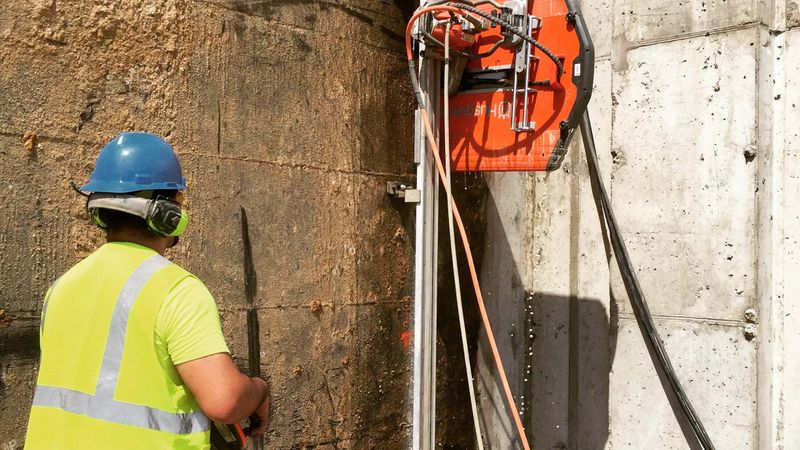
Wall sawing uses a circular diamond blade mounted on a powered saw head that rides along a track bolted to the wall surface. The track guides the blade in a perfectly straight line, and the saw head advances the blade into the concrete at a controlled feed rate. Water is supplied to the blade for cooling, lubrication, and dust control.
Advantages of Wall Sawing
- Precision: The track-mounted system produces perfectly straight, flat cuts. The finished opening has clean, uniform edges that require minimal finishing.
- Depth capacity: Wall saws can cut through concrete walls up to 24 inches thick or more in a single pass, depending on the blade diameter.
- Large openings: Wall sawing is the preferred method for large openings like doorways (up to 36 by 84 inches), egress windows, and commercial pass-throughs. There is essentially no limit to the length of a wall saw cut.
- Speed: For large cuts, wall sawing is significantly faster than handheld methods because the powered feed maintains a consistent cutting speed.
- Operator safety: The operator controls the saw from a position away from the blade, reducing direct exposure to noise, dust, and vibration.
Limitations of Wall Sawing
- Setup time: Mounting the track to the wall, setting up the saw, and connecting the water supply takes more time than simply starting a handheld saw. For very small cuts, this setup time may not be justified.
- Access requirements: The saw and track need adequate clearance on the wall surface. Very tight corners or walls with significant obstructions may not be accessible.
- Overcuts at corners: Because the blade is circular, wall saw cuts extend slightly beyond the intended stopping point at each corner of a rectangular opening. These "overcuts" are typically small (about half the blade radius) and can be finished with a hand saw or ring saw if a clean corner is required.
- Cost: Wall sawing typically costs more than hand sawing for small cuts due to the equipment and setup involved.
Need this done professionally?
REDCORE provides free, no-obligation estimates. Same-day service available.
Get Free Estimate →Or call: +1 (413) 666-2026Handheld (Hand) Sawing
Hand sawing uses a portable cut-off saw, commonly known as a "quick saw" or "partner saw," equipped with a diamond blade. The operator holds and guides the saw manually along the cut line. These saws can be gas-powered, electric, or hydraulic.
Advantages of Hand Sawing
- Quick setup: A hand saw requires virtually no setup. The operator can start cutting within minutes of arriving on site.
- Portability: Hand saws are lightweight and can be carried to almost any location, including upper floors, confined spaces, and areas where wall saw equipment cannot easily reach.
- Flexibility: Hand saws can cut at any angle and can work around obstacles, pipes, and other features that might interfere with a wall saw track.
- Clean corners: Because the operator can stop the cut exactly at the corner, hand sawing does not produce overcuts.
- Lower cost for small cuts: For small openings and limited cuts, hand sawing is more economical.
Limitations of Hand Sawing
- Depth limitation: Most handheld saws are limited to a cutting depth of about 5 to 6 inches. For walls thicker than this, cuts must be made from both sides, and alignment can be challenging.
- Precision: Even an experienced operator cannot match the straightness and flatness of a track-guided wall saw. Hand saw cuts may show slight waviness or deviation from the intended line.
- Physical demand: Hand sawing is physically demanding, especially on vertical and overhead surfaces. Operator fatigue can further reduce cut quality on longer cuts.
- Larger opening size: For large openings, hand sawing is significantly slower and produces less precise results than wall sawing.
When to Use Each Method
Choose Wall Sawing For:
- Egress window openings in foundation walls
- Door openings through concrete walls
- Large rectangular openings for pass-throughs or ductwork
- Any cut through walls thicker than 6 inches
- Projects where clean, straight edges are important for the finished result
- Commercial and structural applications
Choose Hand Sawing For:
- Small openings and limited cuts in thin walls (under 5 inches)
- Cutting in tight spaces where wall saw equipment cannot fit
- Partial-depth cuts (scoring) for decorative or control purposes
- Quick cuts where precision is less critical
- Budget-conscious projects with small scope
REDCORE's Wall Cutting Capabilities
REDCORE Concrete Cutting & Core Drilling maintains both wall sawing and hand sawing equipment to handle any wall cutting project. We will assess your specific project and recommend the method that delivers the best combination of quality, efficiency, and value. Contact us for a free estimate on your wall cutting project in Springfield, MA or anywhere in Western Massachusetts.