
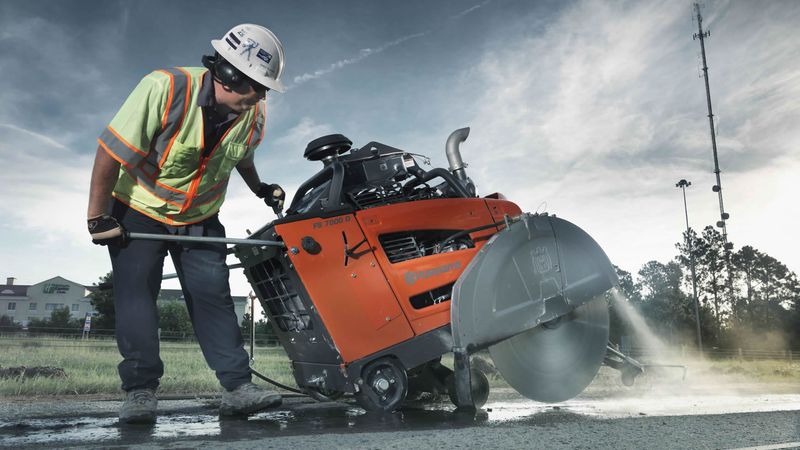
The Foundation of Modern Concrete Cutting
Every professional concrete cut, whether made by a flat saw, wall saw, core drill, or handheld saw, relies on diamond blade technology. Diamonds are the hardest material known, and when bonded to a steel blade or core bit, they provide an unmatched ability to grind through concrete, masonry, asphalt, and even steel reinforcement.
Understanding how diamond blades work gives property owners and contractors a better appreciation of the technology behind professional concrete cutting and helps explain why professional results are so far superior to improvised cutting methods.
How Diamond Blades Work
Contrary to what the name might suggest, diamond blades do not cut concrete the way a knife cuts bread. Instead, they grind it. The diamond particles embedded in the blade segments are exposed at the cutting surface, and as the blade rotates against the concrete, these diamond crystals abrade the material, turning it into fine particles.
As the exposed diamonds wear down and fracture, new sharp diamond crystals are revealed beneath them. This self-sharpening characteristic is what makes diamond blades so effective and long-lasting. The metal bond matrix that holds the diamonds is carefully engineered to wear at a rate that matches diamond exposure, ensuring consistent cutting performance throughout the blade's life.
Anatomy of a Diamond Blade
- Steel core: The central disc (for circular blades) or tube (for core bits) that supports the diamond segments. The core must be precisely manufactured for flatness and balance to prevent vibration during cutting.
- Diamond segments: The cutting portions of the blade, made from a mixture of synthetic diamond crystals and metal powder that is pressed and sintered (heated under pressure) into solid blocks. Segments are brazed or laser-welded to the steel core.
- Gullets: The spaces between segments on a circular blade. Gullets serve multiple purposes: they allow cooling air or water to reach the cutting zone, they provide clearance for cutting debris, and they help dissipate heat.
- Bond matrix: The metal alloy that holds the diamond crystals in place within each segment. The bond hardness is a critical variable. Soft bonds wear faster, exposing new diamonds quickly, and are designed for cutting hard materials. Hard bonds wear slowly and are designed for softer, more abrasive materials.
Need this done professionally?
REDCORE provides free, no-obligation estimates. Same-day service available.
Get Free Estimate →Or call: +1 (413) 666-2026Types of Diamond Blades for Concrete Cutting
Flat Saw Blades (Circular)
These large-diameter blades, ranging from 12 to 72 inches, are used on flat saws (slab saws) for cutting horizontal surfaces. The blade is mounted on a powerful walk-behind saw that rides on the concrete surface. Flat saw blades are available in various segment configurations optimized for different concrete types and cutting conditions.
Wall Saw Blades
Similar to flat saw blades but designed for use on track-mounted wall saws. These blades must handle the additional challenge of cutting on vertical and overhead surfaces, where water management and debris clearance are more difficult.
Core Drill Bits
Cylindrical diamond bits used for drilling round holes. Core bits have diamond segments brazed to the bottom edge of a steel tube. As the bit rotates, it grinds an annular groove in the concrete, leaving a solid cylinder (the core) in the center that is removed after drilling. Core bits range from under 1 inch to over 60 inches in diameter.
Handheld Saw Blades
Smaller-diameter blades (typically 12 to 16 inches) designed for use with portable cut-off saws. These are the most common diamond blades in general construction and are used for a wide variety of cutting tasks.
Wire Saw (Diamond Wire)
Instead of a rigid blade, a diamond wire saw uses a steel cable studded with diamond beads. The wire is looped around the object to be cut and driven by a powered pulley system. Wire saws are used for unusual cuts where a circular blade cannot reach, such as cutting around corners, through very thick sections, or in confined spaces.
Matching the Blade to the Material
Selecting the right diamond blade for the material being cut is critical for performance and blade life:
- Green (uncured) concrete: Very abrasive. Requires hard-bond diamond segments that resist rapid wear.
- Cured concrete: Less abrasive than green concrete. Medium-bond segments provide the best balance of cutting speed and blade life.
- Heavily reinforced concrete: The combination of concrete and steel requires segments specifically designed for both materials. Some blades use alternating segment types optimized for concrete and metal.
- Asphalt: Highly abrasive. Requires the hardest bond formulations to prevent premature segment wear.
- Brick and block: Generally easier to cut than poured concrete. Softer bonds provide faster cutting in these materials.
Why Diamond Blades Are the Industry Standard
Before diamond blades became widely available in the 1960s and 1970s, concrete was cut using abrasive blades, which wore down rapidly, or by jackhammering, which was imprecise and destructive. Diamond blade technology revolutionized the industry by offering:
- Dramatically longer blade life compared to abrasive blades
- Clean, precise cuts impossible to achieve with percussion methods
- The ability to cut through any concrete, regardless of hardness or reinforcement
- Reduced noise and vibration compared to demolition methods
- Less dust and debris when used with wet cutting methods
REDCORE Uses Premium Diamond Tooling
At REDCORE Concrete Cutting & Core Drilling, we invest in premium diamond blades and core bits that deliver superior cutting performance and clean results. Our blade inventory is matched to the variety of concrete types and conditions we encounter across Springfield, MA and Western Massachusetts. This investment in quality tooling translates directly to better results for our clients. Contact us to put our expertise and equipment to work on your next project.